

At Phoenix Software, publishing our Gender Pay Gap Report is not simply a regulatory obligation – it reflects who we are and the kind of organisation we are committed to becoming. We believe that a truly inclusive workplace is one where people are valued, rewarded, and supported equitably, regardless of gender. Transparency is the foundation of that commitment.
This report is based on data from the snapshot date of 5th April 2025 and includes 458 employees across our organisation. Of these, 306 are male and 152 are female.
We share it with our Board, publish it openly, and use it to hold ourselves accountable for meaningful, measurable progress.
Understanding the Gender Pay Gap
The gender pay gap is not the same as unequal pay. It measures the difference between the average earnings of all men and all women across our organisation, regardless of their role or seniority. It reflects the overall distribution of men and women across pay levels – and in our industry, as in most technology businesses, that distribution is shaped by structural challenges that take sustained effort to change.
Mean pay gap compares the average hourly pay of all men and all women. Median pay gap compares the midpoint of male and female earnings when ranked lowest to highest. Bonus pay gap is calculated based on bonuses paid in the 12 months prior to the snapshot date.
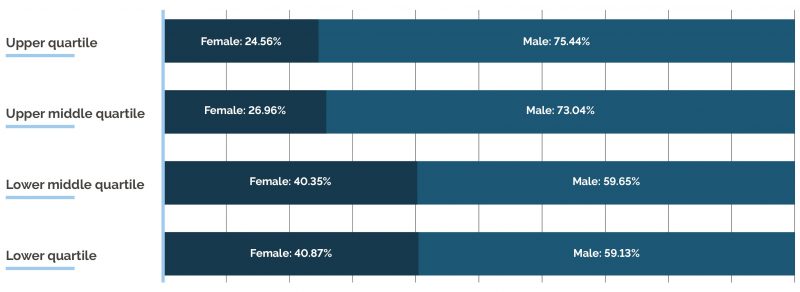
2025 quartiles:
What the data tells us
Our mean and median hourly pay gaps have widened this year, and we take that seriously. However, we also believe it is important to look at the full picture – because the story behind the numbers is more nuanced than the headline figures suggest.
Where we have made progress: The median bonus gap has moved – and moved significantly – in favour of women, shifting from 0% to −30.38%. This tells us that the experience of women in the middle of our bonus distribution has improved materially.
What is driving the widening gap: Our workforce grew over the past year, and that growth was not evenly distributed. We added 33 men and 10 women to our overall headcount, with a notable increase in male representation across our Consultancy and IT Services teams. This shift in workforce composition – rather than changes in how we pay individuals in comparable roles – is the primary driver of the widened mean and median gaps.
In other words: the gap has widened largely because of who has joined us, and where they sit in our pay structure, rather than because women at Phoenix are being paid less for equivalent work. That distinction matters – but it does not diminish our responsibility to act.
Our workforce at a glance
Phoenix Software is proud to be an employer where women represent approximately 35% of our workforce — significantly above the technology industry average of around 20%. Our Board is 25% female. These are meaningful indicators of the inclusive culture we have built, and they provide a strong foundation from which to address the challenges our pay gap data highlights.
Our gender pay gap does not exist because we pay women less for the same work. It exists because, like most technology businesses, we have more men than women in our highest-earning roles – and more work to do to change that balance.
What we are already doing about this
We already have a strong foundation of measures, programmes and policies in place to promote fairness, inclusion and opportunity across Phoenix. These include:
Inclusive development and mentoring
- Ensuring men and women have equal access to both formal and informal mentoring opportunities.
- Maintaining an internal mentoring programme that supports employees across the business.
- Continuing our Shadowing Programme, giving employees visibility of other roles, teams and career paths.
- Running our Group‑wide ‘CEO for a Day’ programme, providing employees with development, inclusion and leadership insights through direct time with our female Group CEO.
Safe, respectful and harassment‑free workplace
- Embedding robust measures to prevent harassment (including sexual harassment) through our policy, manager training and clear, safe reporting routes.
- Training all managers on unconscious bias as part of our ongoing people and culture development plan.
- Training managers through our LEAP (Leadership Excellence in Phoenix) programme to lead by example, address inappropriate behaviour proactively and manage people effectively.
Fair and inclusive recruitment
- Using structured interviews for recruitment and promotions to reduce bias and ensure consistency.
- Using diverse interview panels, supported by our pool of Culture Champions, to bring varied perspectives to selection decisions.
- Using inclusive language across all recruitment adverts, including encouraging under‑represented groups to apply.
- Attracting and hiring returners, ensuring our recruitment processes are non‑biased and supportive for those re‑entering the workforce after extended career breaks.
- Promoting part‑time, job‑share and flexible working roles to broaden our talent pool and support those with caring responsibilities.
- Encouraging women into sales and technical roles through internal promotion, external recruitment, and outreach activity with schools and colleges.
Supporting employees and enabling work–life balance
- Providing enhanced family leave packages, supporting all types of families.
- Encouraging greater take‑up of paternity leave and shared parental leave, fostering a culture where people feel confident requesting this.
- Providing support for employees experiencing menopause symptoms, including training, policy awareness and access to our internal menopause ERG.
- Providing all employees with access to Wellness Cloud, offering wellbeing support, counselling, coaching and specialist sessions across a wide range of topics.
- Supporting expectant parents with additional expert sessions to help prepare for parenthood and return to work.
Fair pay, progression and employee experience
- Reviewing employee salaries annually to ensure alignment with market and industry benchmarks.
- Ensuring personal development and progression paths are discussed regularly and in a meaningful, realistic way.
- Conducting open and honest exit interviews to understand experiences and reasons for leaving.
- Continuing to improve workplace flexibility for everyone, designing flexible roles and equipping managers to support flexible workers.
- Reviewing all stages of the employee lifecycle to maintain fair and inclusive people-management practices.
Representation, belonging and role modelling
- Ensuring women are represented across our visual assets and marketing collateral.
- Providing visible female role models, including a female Managing Director and Group CEO.
- Supporting our internal employee resource groups (ERGs) – covering wellbeing, neurodiversity, women in tech, men in tech, and LGBTQIA+ – to drive awareness, connection and action.
What we are doing about this moving forwards
We are not approaching this report as a compliance exercise. The data gives us a clear direction, and we are committed to taking structured, evidence-based action across six priority areas over the coming year.
1. Strengthen recruitment to address workforce imbalance
While we already ensure inclusivity in our recruitment practices, the data shows we need additional, targeted interventions to address gender imbalance in applicant flow and hiring outcomes. This year we will:
- Audit recruitment channels and partnerships to identify where we over‑index male applicants and diversify our sourcing based on evidence.
- Enhance our existing diverse interview panels by introducing clearer expectations, guidance and calibration to strengthen objectivity in hiring decisions.
- Expand our external attraction activity, scaling beyond our current outreach to schools/ colleges to include new channels, networks and events that specifically reach under‑represented genders in technical and commercial roles.
2. Conduct a structured pay equity review
Our annual salary reviews ensure market alignment, but they do not fully reveal the drivers of gender pay differences. This year we will introduce:
- A comprehensive, role-by-role pay equity audit, using specialist methodology to identify disparities within comparable roles, levels and functions.
This is a new, deeper diagnostic – distinct from our annual salary review process.
3. Investigate and address bonus gap drivers
To fully understand the widening mean bonus gap, we will introduce new analysis and structural review:
- Investigate bonus outcomes to pinpoint where gender disparities emerge, with particular focus on commission‑earning and commercial roles.
- Continue to review and update bonus and performance rating to ensure they are evidence-based, objective, and consistently applied across all functions.
This targeted review goes beyond the general fairness principles and bias training already in place.
4. Build a stronger pipeline for career progression
While we already offer mentoring, shadowing, and development conversations, the next phase focuses on formalising pathways and accelerating progression. Over the next year we will:
- Create a structured development pathway for women aspiring to management and technical specialist roles, expanding on – but distinct from – our existing informal mentoring and shadowing programmes.
- Introduce a focused development cohort, providing tailored opportunities such as confidence‑building, navigating organisational barriers, and developing commercial acumen (including P&L awareness).
- Publish transparent promotion criteria, ensuring all employees have equitable visibility of what is required for progression.
- Expand targeted attraction initiatives for women into technical and senior commercial positions, building on but clearly extending existing efforts.
5. Improve mid-career retention for women
We already provide strong wellbeing support, flexible working, enhanced family leave and menopause resources. To address mid-career drop‑off specifically, we will introduce:
- Stay interviews for mid‑to‑senior women, identifying barriers before they materialise into attrition.
- A structured returner pathway, offering clearer routes back into the organisation for women returning after extended career breaks (an expansion of our current “returner-friendly” recruitment approach).
- A visibility programme that actively showcases women’s career stories, helping to normalise progression routes and inspire future leaders.
These actions are new, focused interventions intended to complement – rather than duplicate – existing wellbeing and flexibility support.
6. Build manager capability around bias, equity and inclusion
While unconscious bias training and LEAP are already in place, our next step is to embed role-specific accountability for equity in pay, performance and progression decisions. We will:
- Introduce advanced, mandatory training for line managers focused specifically on decision‑making in areas where bias has the highest impact: salary, performance ratings, promotions and talent assessment processes.
- Scale and extend our Shadowing Programme to ensure better cross-functional visibility – particularly for women exploring development into new technical, commercial, or leadership areas.
These actions go further than the general bias training and people management expectations already in place.
Looking ahead
We recognise that closing a gender pay gap – especially in an industry as historically male-dominated as technology – takes sustained commitment and time. The steps we are taking this year are more structured, more data-driven, and more targeted than before.
Phoenix Software’s gender split already outperforms the industry average. Women hold senior leadership positions at our Board and across our leadership team. The positive movement in our highest quartile shows that our efforts to develop and promote female talent are beginning to take effect.
We will continue to publish this report annually, to share our progress honestly, and to hold ourselves to account – because transparency is not just a policy at Phoenix. It is a value.
Our declaration
We confirm that our data has been calculated in accordance with the requirements of the Equality Act 2010 (Gender Pay Gap Regulations 2017) and has been produced by our Payroll function and approved by our Finance Director.
Last revised: 24 March 2026