


From Copilot to AI agents: how charities are taking the next step with AI
6 minute read
Lewis Thomson
June 11th, 2026
Forward-thinking charities are beginning to explore something bigger than AI assistance: AI autonomy. Enter AI Agents. Intelligent digital teammates capable of carrying out tasks, surfacing insights, and supporting teams without constant manual prompting.
From fundraising and volunteer engagement to grant applications and case management, charities are beginning to use tools like Microsoft 365 Copilot and Copilot Studio to reduce pressure on overstretched teams and create more time for what matters most: delivering impact.
AI in charities has moved beyond experimentation
The charity sector has never lacked innovation. It’s simply lacked time, budget, and resource.
That’s why AI adoption within nonprofits has accelerated so quickly over the past 18 months. Organisations are realising that AI isn’t about replacing people, it’s about removing friction.
AI adoption across nonprofit and public sector organisations continues to grow rapidly, particularly around administrative automation, donor communications, and knowledge management. For charities balancing increasing demand with limited funding, the opportunity is difficult to ignore.
The first wave of adoption focused on AI assistants like Microsoft Copilot helping employees work faster by completing admin tasks. But more digitally mature charities are now asking a new question:
What if AI could actually complete tasks on our behalf?
That’s where Agents come in.
What are AI agents?
Think of an AI Agent as the evolution of the traditional chatbot.
Instead of simply responding to prompts, AI Agents can:
- Follow processes
- Retrieve information from multiple systems
- Trigger workflows
- Make recommendations
- Complete repetitive tasks automatically
- Interact with users conversationally
In practice, this could look like:
- An agent helping volunteers find policies and onboarding documents instantly
- A fundraising agent surfacing donor insights before a campaign launch
- A support Agent helping staff navigate complex case information
- An internal HR Agent answering policy questions 24/7
- A grants Agent helping identify suitable funding opportunities
The key difference?
Copilot helps people do tasks faster, agents do the tasks themselves.
Why charities are well-positioned for AI agents
Charities are under constant pressure to do more with less. Teams are often stretched across multiple responsibilities, while administrative demands continue to grow.
AI agents offer an opportunity to reduce operational burden without compromising service quality.
And importantly, they don’t require massive internal development teams to get started.
With tools like Copilot Studio, organisations can begin building tailored agents using the systems and information they already have access to. That means charities can create secure, organisation-specific AI experiences that align with their processes, governance, and goals.
Download our free guide for charities
Phoenix supports UK charities with simple, honest, and expert technology advice so they can keep doing what matters most. Download the guide to see how AI can help you focus more time on your mission.
Read the guide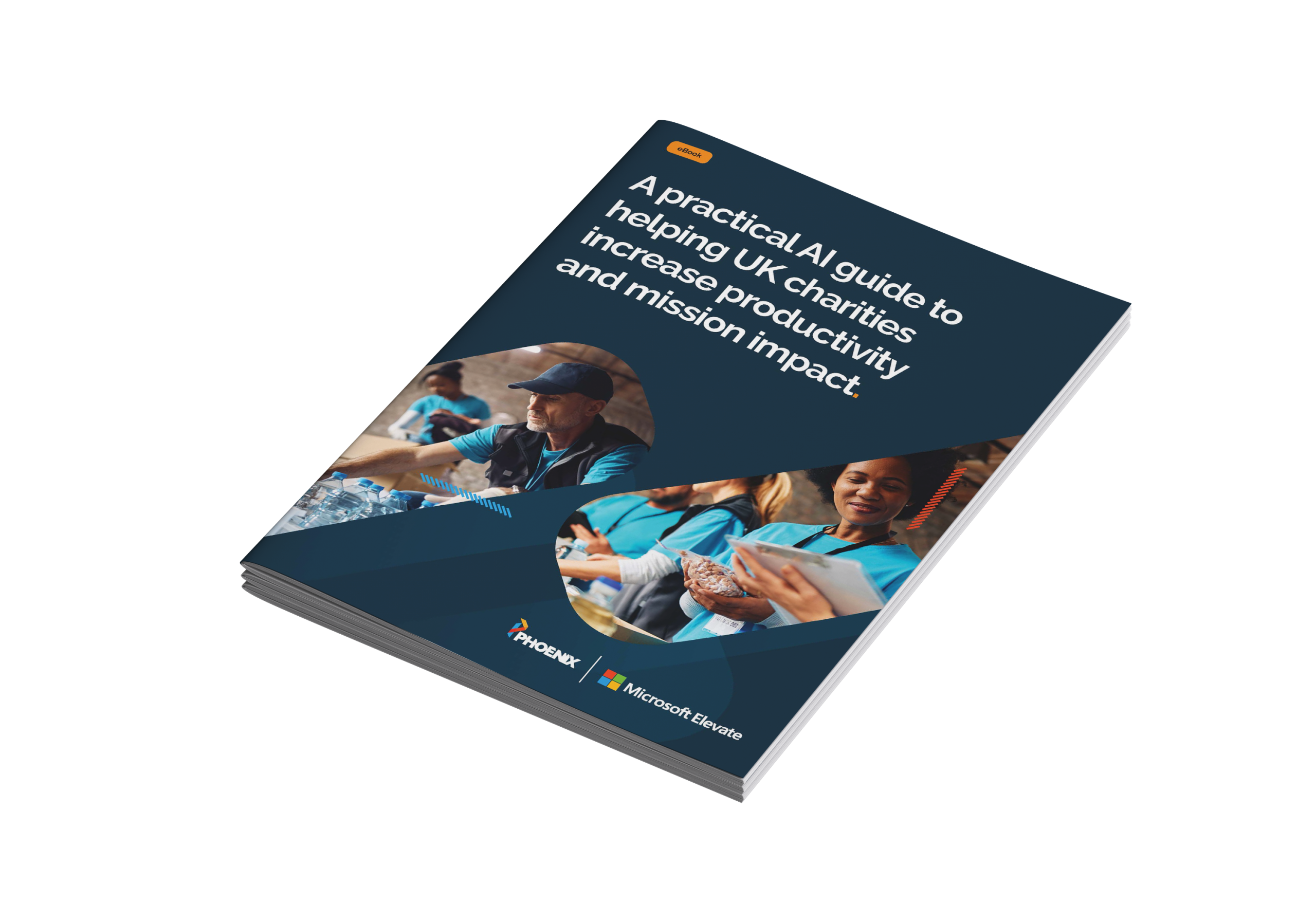
The real opportunity: freeing people to focus on people
One of the biggest misconceptions around AI is that it’s purely about efficiency.
In charities, the real value is capacity.
Every hour saved on admin is another hour spent:
- Supporting beneficiaries
- Building donor relationships
- Planning campaigns
- Applying for funding
- Delivering frontline services
The organisations seeing the most success with AI aren’t replacing human interaction. They’re protecting it.
Moving from AI curiosity to AI strategy
Many charities are still in the early stages of their AI journey, but the organisations gaining momentum are moving beyond isolated experimentation and beginning to think strategically:
- Where are our biggest operational bottlenecks?
- Which repetitive processes consume the most time?
- What knowledge is difficult for staff to access?
- Where could automation improve service delivery?
- How do we introduce AI securely and responsibly?
Governance matters just as much as innovation
For charities especially, trust, compliance, safeguarding, and data security remain critical considerations.
That’s why successful AI adoption requires:
- Clear governance policies
- Secure data foundations
- Responsible AI frameworks
- User training and adoption planning
- Transparency around how AI is being used
What happens next?
The charities leading the way with AI aren’t necessarily the biggest, they’re the ones willing to explore where technology can remove pressure, empower employees, and improve outcomes.


About the author
Lewis Thomson, AI Workforce Lead.
Lewis joined Phoenix in February 2020 to build out Phoenix’s FastTrack Programme. Since then, Lewis has taken on various new roles, including buildling out Phoenix’s Viva and Copilot offerings, managing a team of three, achieving the Microsoft FastTrack POTY Finalist position in 2023, and becoming a Microsoft MVP. Lewis is passionate about providing new technology to organisations and showcasing how this can help them do more with less.