



How to get your council LGR-ready following local elections
4 minute read
Lucie Collings
May 19th, 2026
The votes have been counted, the results are in, and across England, local government will never quite look the same. The May 2026 local elections didn’t just reshape the political map, they officially marked the next chapter.
For councils undergoing Local Government Reorganisation (LGR), the countdown to Vesting Day on 1 April 2028 has now begun. The question isn’t whether change is coming. It’s whether your council will be ready when it does.
A political earthquake, and what it means for your council
Last week’s local elections confirmed what many in the sector already suspected: England’s local government landscape is being redrawn. Not just politically, but structurally.
Following the English Devolution White Paper published in December 2024, the Labour government set out its ambition to abolish two-tier county and district council structures and replace them with single-tier unitary authorities. This led to over 70 proposals submitted by councils across 21 invited areas. And with the government having already announced decisions on the footprints of new unitary authorities in Essex, Norfolk, Suffolk, and Hampshire in March 2026, the LGR programme is accelerating fast.
The numbers tell the story. Across England, most new unitary authorities are expected to hold their first elections in May 2027, with Vesting Day (the moment the old councils are legally dissolved and the new authorities go live) set for 1 April 2028. Surrey is moving even faster, with East Surrey Council and West Surrey Council replacing the existing county and eleven district councils from 1 April 2027.
For council IT, digital, and transformation teams, this isn’t an abstract policy debate. It’s a hard deadline with very real consequences.
The challenge nobody wants to underestimate
LGR is, without question, one of the most complex operational challenges a council will ever face. Think about what’s involved: multiple organisations, each with their own IT infrastructure, software contracts, email domains, data siloes, licensing arrangements, and staff who need to feel confident and productive from the moment the new council goes live.
And then consider the stakes. Citizens don’t care which legacy system their council is migrating from. They just want their services to run as planned:, planning applications processed, social care appointments kept, and bins collected.
This is why the framing matters. LGR isn’t just a merger. It’s the creation of something entirely new, built on the foundations of what came before, and it has to work from Day One.
What “Day One” actually means
At Phoenix, we’ve supported councils through exactly this kind of transformation, from North Yorkshire Council and Cumberland Council and Westmorland & Furness Council, to Cheshire East. What we’ve learned from guiding those authorities through Vesting Day is that success doesn’t happen on the day itself. It’s the result of months of careful preparation beforehand.
The LGR journey has three distinct phases, and each one is critical.
Phase 1: Pre-vesting: before a single system is migrated, councils need to know exactly what they’re working with. That means auditing your full technology estate: users, devices, software, network schematics, and licensing arrangements
Phase 2: Day One: on Vesting Day itself, the overriding priority is simple: don’t break anything. The new authority must present a single, unified identity to the outside world, regardless of which predecessor organisation its staff have come from
Phase 3: Beyond Day One: with Vesting Day successfully navigated, the real opportunity opens up. Rather than simply inheriting and maintaining the combined legacy of predecessor organisations, this is the moment to modernise
Where Phoenix comes in
Phoenix is one of Microsoft’s most accredited UK partners, holding both Solutions Partner and Frontier Partner status. With 35 years of experience working exclusively with the UK public sector, we understand the pressures councils are under like few others do. Our LGR support spans the entire journey, from early discovery and licensing rationalisation through to identity consolidation, Microsoft 365 unification, and post-vesting optimisation. That includes:
- Identity and unified tenant
- Microsoft 365 migration
- Infrastructure and endpoints
- Data and AI
- Security and compliance
- Licensing, ITAM, and FinOps
- Adoption and change management
The decisions you make now will shape the next decade
With Vesting Day on the horizon, the window for preparation is open, but it won’t stay open forever. The technology decisions made now will shape service delivery, staff productivity, and citizen experience for decades to come. Councils that treat LGR as a crisis to be managed will find it costly and chaotic. Councils that treat it as an opportunity to build something better will come out the other side stronger, more efficient, and better equipped to serve their communities.
The question worth asking now is: what kind of council do you want to be on 2 April 2028?
Want to learn more?
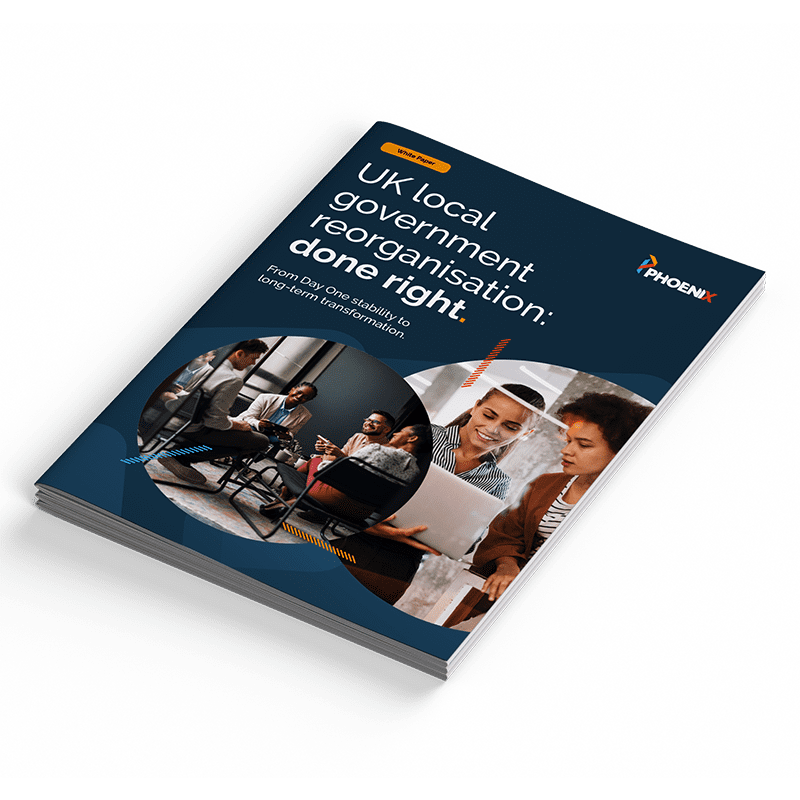
Download the whitepaper to discover how councils can navigate Local Government Reorganisation with confidence, minimise disruption on Vesting Day, and build a stronger, future-ready authority for 2028 and beyond.

About the author
Lucie Collings, Divisional Director – Government and Public Safety
As the Divisional Director for Government and Public Safety at Phoenix, Lucie Collings joined Phoenix in 2003 with over 25 years of industry experience. Lucie is committed to helping public sector customers on their digital transformation journey. Her focus is on enabling customers to maximise and realise the value of their IT investments, in order to deliver better services to their citizens. Lucie’s dedication to her customers’ success is evident in her efforts to help them achieve their goals.