



The Microsoft security strategy your organisation is missing
6 minute read
Steph Ireland
March 11th, 2026
Recently, during a security review workshop, a customer told us something refreshingly honest: “We don’t think we have a technology problem, we think we have a visibility problem.”
They had endpoint protection. Email filtering. Identity controls. Even SIEM in place. But their team still felt reactive, stretched, and uncertain about real risk.
This is a pattern we see across sectors. Many organisations have invested in strong individual controls, yet their Microsoft security solutions aren’t delivering the full value they could.
The hidden challenge: security tool sprawl
Over the past decade, cyber security stacks have grown organically. New threats emerged, new tools were added, and environments became increasingly layered.
- The unintended consequence?
- Fragmented visibility
- Duplicated alerts
- Inconsistent policy enforcement
- Growing analyst workload
Even within the Microsoft ecosystem, we frequently see organisations running powerful capabilities in isolation rather than as an integrated security platform.
Why integration is now a security priority
Modern attacks rarely target just one layer. A typical breach path might involve:
- A phishing email
- A compromised identity
- Lateral movement across endpoints
- Data exfiltration from cloud apps
If each signal sits in a different console, the pattern can be difficult to spot until it’s too late.
This is where Microsoft’s security architecture is designed to work differently. When tools like Microsoft Defender and Microsoft Sentinel are properly aligned, organisations gain:
- Cross-domain visibility
- Automated signal correlation
- Prioritised incident queues
- Faster response times
The value isn’t simply more alerts, it’s better context.
The maturity gap most dashboards don’t show
One of the more surprising realisations we’ve had is how often environments appear healthy at surface level but still contain operational gaps.
Common examples include:
- Defender deployed but not fully integrated across workloads
- Sentinel ingesting logs but lacking tuned analytics rules
- Overlapping policies between security tools
- Limited automation of routine response actions
- High alert volumes masking genuine threats
Strengthening your Microsoft cyber security strategy is less about adding controls and more about making existing investments work together intelligently.
What “good” Microsoft security looks like in 2026
From our experience supporting UK organisations, the most resilient environments typically share four characteristics.
- Security signals are unified
Telemetry from identity, endpoints, email, and cloud workloads feeds into a central analytics layer, typically via Microsoft Sentinel. - Noise is actively reduced
Analytics rules and Defender policies are tuned regularly to minimise false positives and prevent analyst fatigue. - Response is increasingly automated
Playbooks handle common containment steps, allowing security teams to focus on higher-value investigation. - Security is continuously optimised
Rather than a one-time deployment, the Microsoft security stack is treated as an evolving capability.
This operational mindset is often the difference between reactive defence and genuine cyber resilience.
Want the full 2026 Microsoft security roadmap?
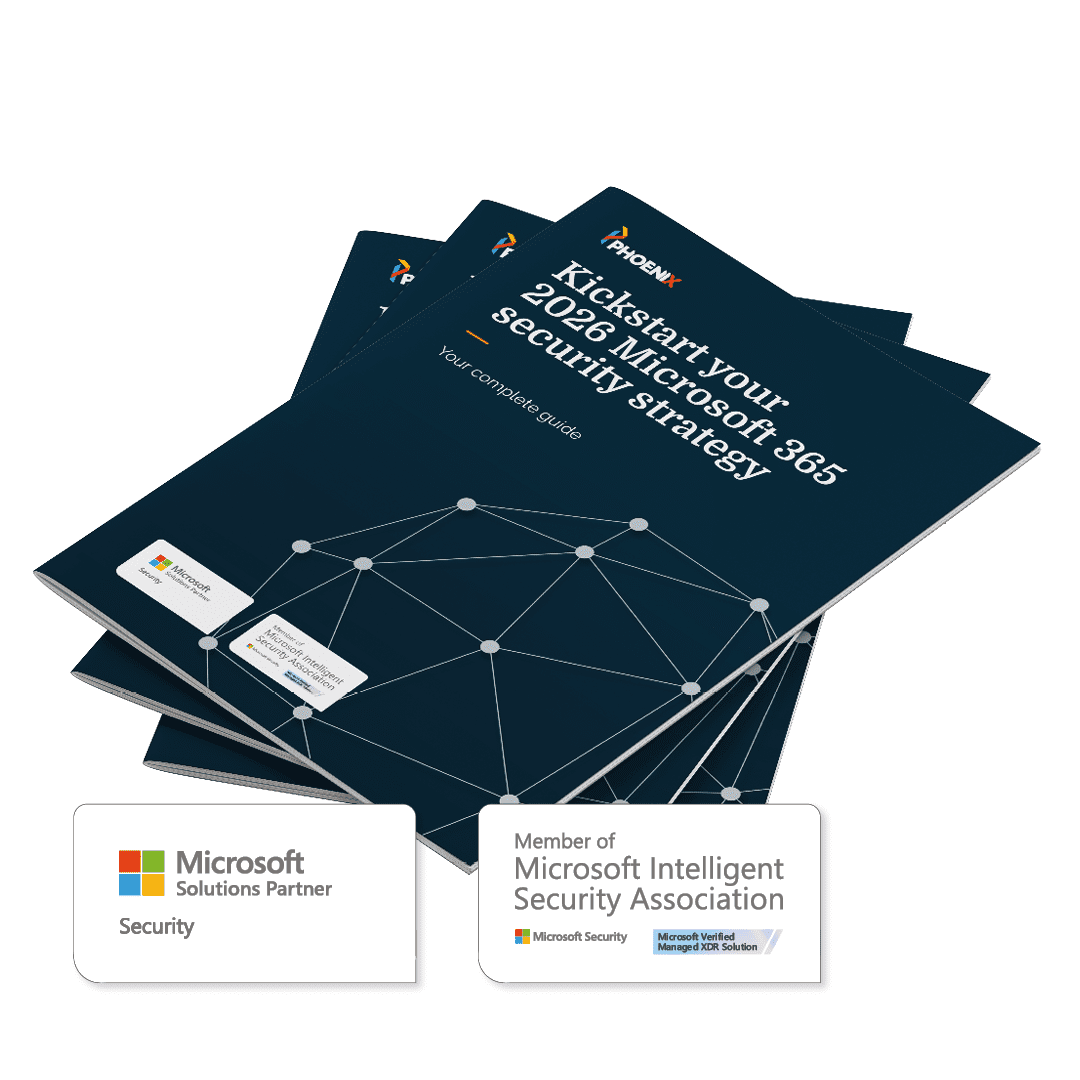
If this topic has highlighted gaps or opportunities in your environment, our latest whitepaper goes much deeper. “Kickstart your 2026 Microsoft 365 security strategy” breaks down the real-world risks we’re seeing across UK organisations, and the practical steps to strengthen your Microsoft security posture.
Inside, you’ll discover:
- Where most Microsoft 365 environments are still exposed
- How AI and Copilot are changing the risk landscape
- What unified defence really looks like in practice
- The priority actions to take now for 2026 readiness
Download the whitepaper to get the complete picture and build a clearer, more confident Microsoft security strategy.
Where organisations typically get stuck
In most cases, the gap isn’t awareness, it’s time and capability. Security and IT teams consistently tell us they are juggling expanding attack surfaces, increasing compliance pressure, limited specialist resource, and ever-changing Microsoft features.
The result is that environments which started strong can gradually drift over time: policies age, new capabilities go unused, and alert volumes begin to creep up. This is exactly where focused optimisation can deliver meaningful security gains without requiring major new investment.
How we’re here to help you get more from Microsoft security
Working closely with customers across education, public sector, and commercial environments, Phoenix helps organisations turn capable tooling into cohesive defence.
Our Microsoft security specialists typically support with:
- Security posture and configuration reviews
- Defender and Sentinel optimisation
- Alert noise reduction
- Automation strategy development
- Ongoing security maturity improvement
The goal is simple: ensure Microsoft security solutions operate as a connected, intelligence-led platform rather than a collection of individual tools.
Your journey to Microsoft security maturity
Cyber threats aren’t slowing down, and neither is the Microsoft security ecosystem. But the organisations seeing the greatest benefit aren’t necessarily the ones with the most tools, they’re the ones that have stepped back and asked a more strategic question:
Are our security investments working together as effectively as they could be?
We believe the future of cyber resilience lies in integration, optimisation, and continuous improvement. Get in touch with our Microsoft Specialists to find out more.


About the author
Stephanie Ireland, Microsoft Security Solutions Lead.
Steph supports the UK public sector to help strengthen their security posture and adopt modern Microsoft security solutions with confidence. With a strong focus on practical outcomes,